• Research
  • People
  • Publications
  • Contact
  • Join
Menu

Wearable and Embodied AI Lab

Street Address
City, State, Zip
Phone Number

Your Custom Text Here

Wearable and Embodied AI Lab

  • Research
  • People
  • Publications
  • Contact
  • Join
visio-tactile01.png

Visio-Tactile Manipulation with Occlusion

Reliable dexterous manipulation requires continuous estimation of object geometry and hand–object contact throughout interaction. With egocentric sensing, however, the manipulating hand frequently occludes task-relevant object surfaces and contact regions, reducing the visual evidence available for state estimation making robust closed-loop control and generalization to unseen object geometries particularly challenging.

To address this, we present OccluDex, a hierarchical 3D visuo–tactile representation learning framework that integrates global geometric structure with local contact information for robust manipulation under dynamic self-occlusion during hand–object interaction. OccluDex adopts multi-scale masked autoencoding to progressively encode partial 3D geometry and fuses tactile contact tokens with high-level geometric features through cross-modal attention. The encoder is pretrained from synchronized human visuo–tactile demonstrations and transferred as a frozen perceptual backbone for downstream reinforcement learning.

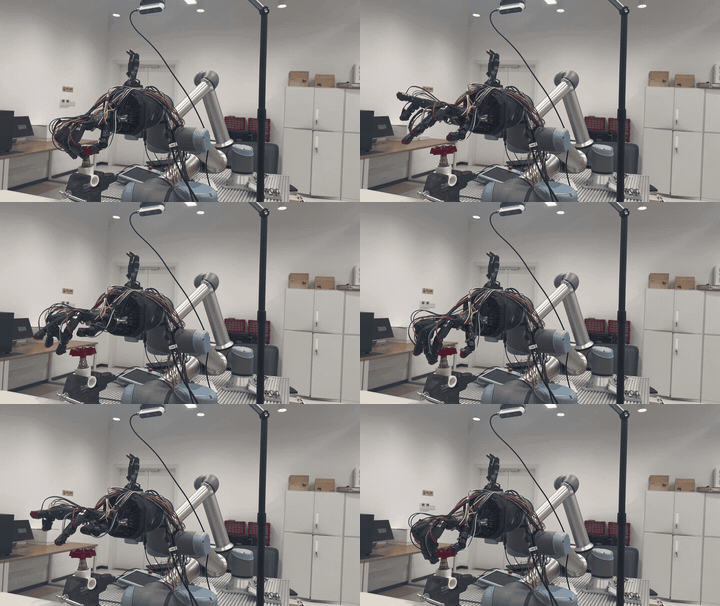
We evaluate OccluDex on a faucet rotation task, requiring one full clockwise handle revolution, and a tabletop object reorientation task, requiring a 180° tabletop object reorientation without toppling. In simulation experiments, OccluDex demonstrated higher accuracy for unseen objects and higher accuracy for previously seen objects than the strongest state-of-the-art baseline models.

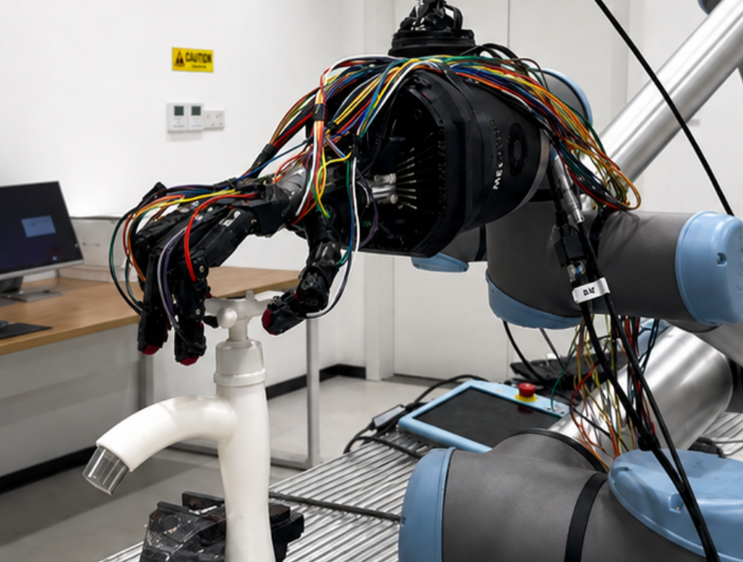
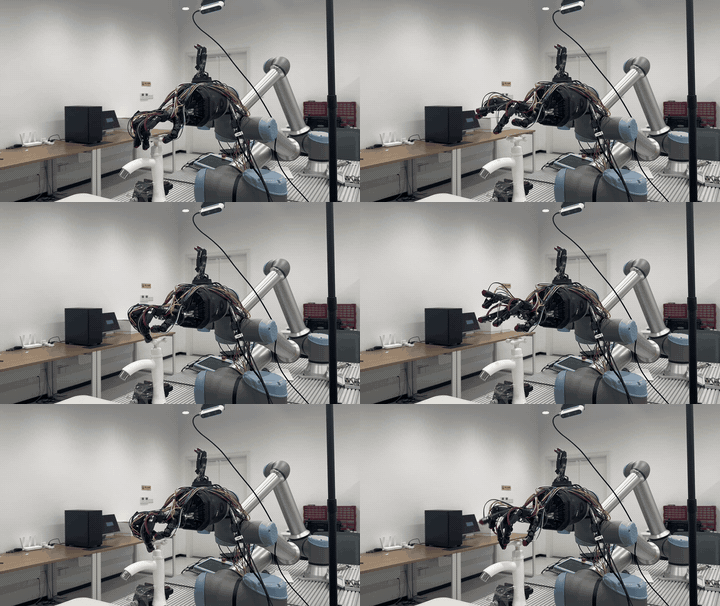
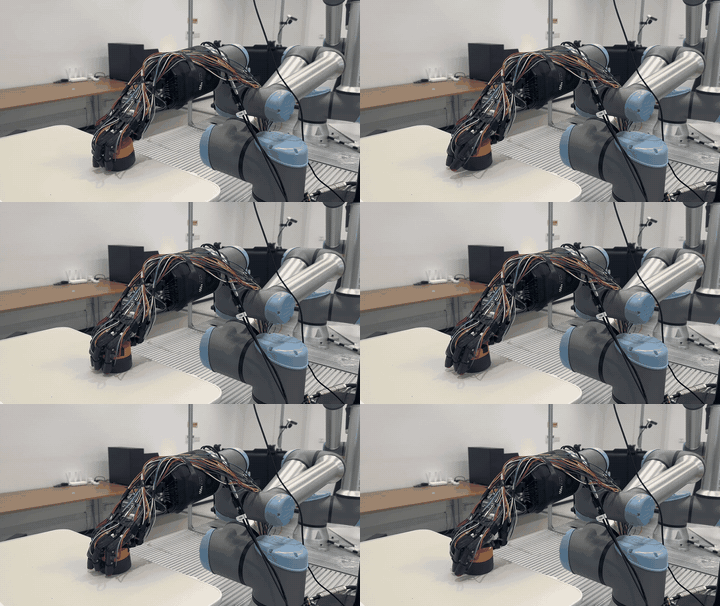
Physical experiments were further performed with a Shadow Hand to demonstrate successful zero-shot sim-to-real generalization on unseen physical objects. These results could enable humanoid egocentric object manipulation for seen and unseen objects even when the manipulating robotic hand occludes vision.
Visio-Tactile Manipulation with Occlusion

Reliable dexterous manipulation requires continuous estimation of object geometry and hand–object contact throughout interaction. With egocentric sensing, however, the manipulating hand frequently occludes task-relevant object surfaces and contact regions, reducing the visual evidence available for state estimation making robust closed-loop control and generalization to unseen object geometries particularly challenging.

To address this, we present OccluDex, a hierarchical 3D visuo–tactile representation learning framework that integrates global geometric structure with local contact information for robust manipulation under dynamic self-occlusion during hand–object interaction. OccluDex adopts multi-scale masked autoencoding to progressively encode partial 3D geometry and fuses tactile contact tokens with high-level geometric features through cross-modal attention. The encoder is pretrained from synchronized human visuo–tactile demonstrations and transferred as a frozen perceptual backbone for downstream reinforcement learning.

We evaluate OccluDex on a faucet rotation task, requiring one full clockwise handle revolution, and a tabletop object reorientation task, requiring a 180° tabletop object reorientation without toppling. In simulation experiments, OccluDex demonstrated higher accuracy for unseen objects and higher accuracy for previously seen objects than the strongest state-of-the-art baseline models.

Physical experiments were further performed with a Shadow Hand to demonstrate successful zero-shot sim-to-real generalization on unseen physical objects. These results could enable humanoid egocentric object manipulation for seen and unseen objects even when the manipulating robotic hand occludes vision.
visio-tactileGIF01.gif
visio-tactileGIF02.gif
visio-tactileGIF03.gif
Featured
Real-Time Orientation Estimation
October 16, 2018
Real-Time Orientation Estimation
October 16, 2018

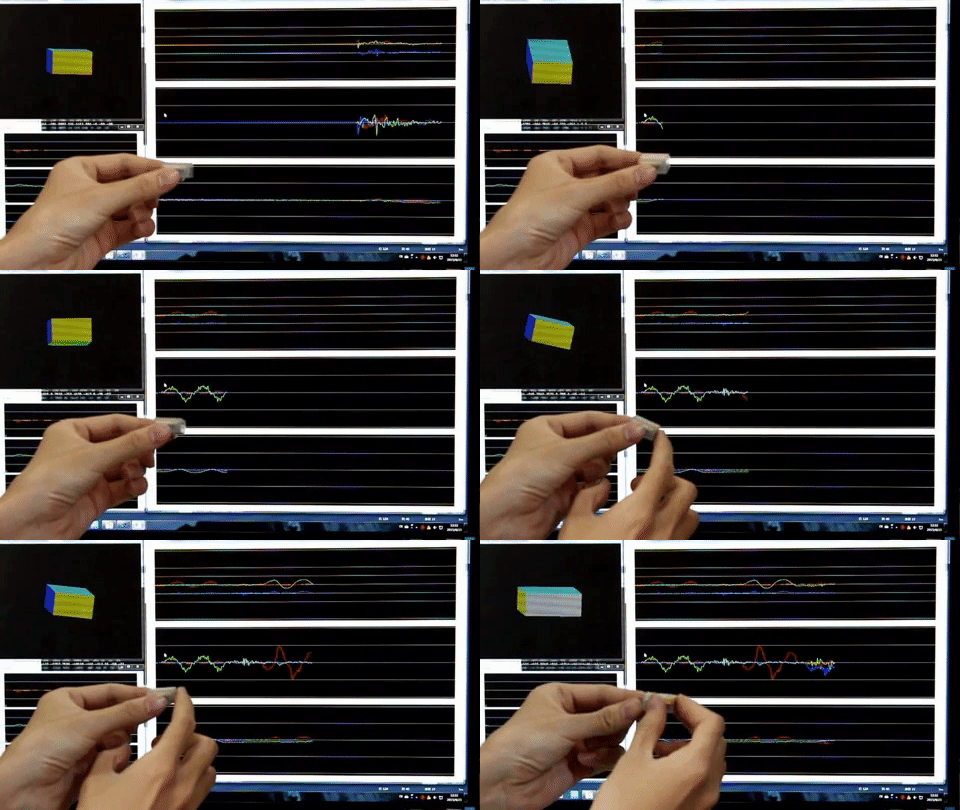
Orientation estimation performed via 3-axis accelerometer, 3-axis gyroscope, and 3-axis magnetometer sensor fusion

Read more →
October 16, 2018