• Research
  • People
  • Publications
  • Contact
  • Join
Menu

Wearable and Embodied AI Lab

Street Address
City, State, Zip
Phone Number

Your Custom Text Here

Wearable and Embodied AI Lab

  • Research
  • People
  • Publications
  • Contact
  • Join
retargeting04.png

Kinematic-Tactile Dexterous Retargeting

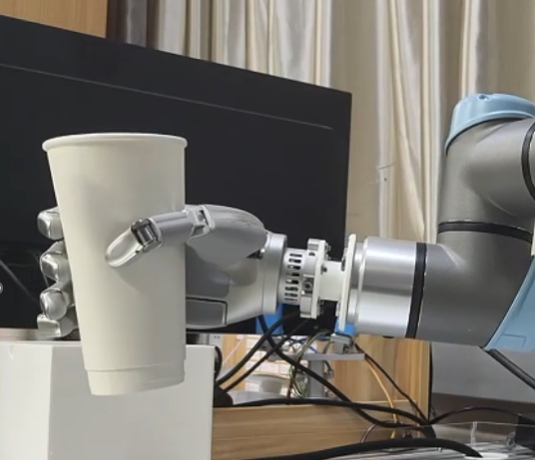
Human demonstrations provide a natural and scalable source of data for learning dexterous manipulation policies. However, existing retargeting methods primarily transfer human kinematics, while the tactile information underlying physical interaction is rarely preserved across embodiments. To address this limitation, we present a hierarchical three-stage framework for kinematic-tactile aligned dexterous retargeting.

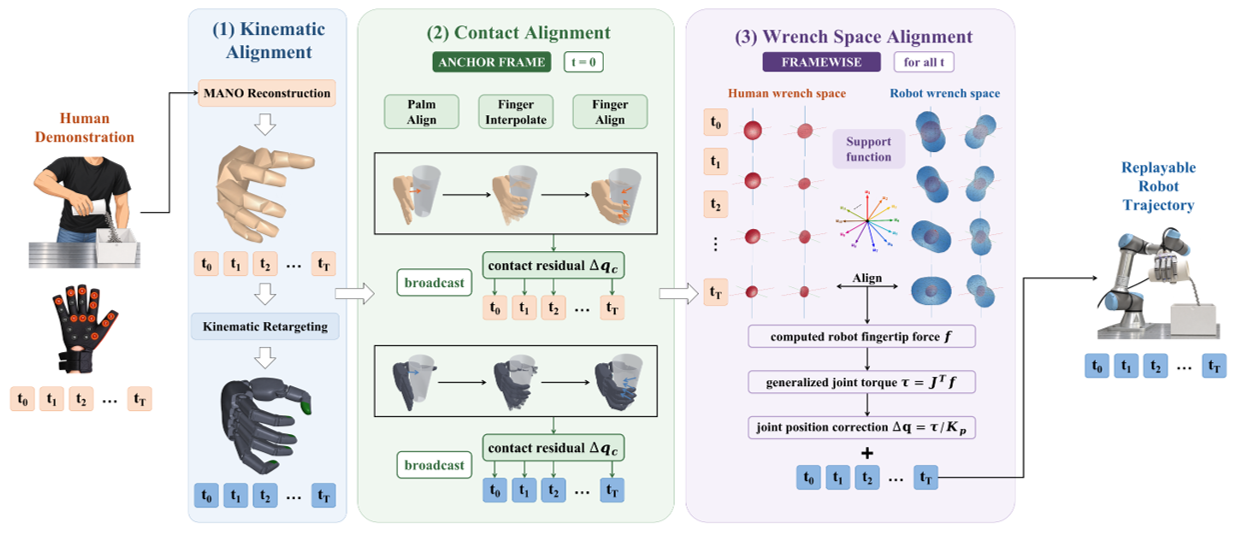
We use object-centric contact wrench space as a physical representation for tactile alignment between human and robot hands. The framework first aligns hand kinematics and contact geometry, and then constructs a human wrench support profile from tactile forces and contact geometry. Robot fingertip force targets are subsequently optimized to cover the human wrench support and converted into joint position corrections, yielding directly replayable robot hand trajectories. We evaluate the framework in simulation and real robot experiments across three pouring conditions.

The framework enables physically grounded transfer of kinematic and tactile information from human demonstrations to robot hands, providing a path toward scalable learning of contact-rich dexterous manipulation.
Kinematic-Tactile Dexterous Retargeting

Human demonstrations provide a natural and scalable source of data for learning dexterous manipulation policies. However, existing retargeting methods primarily transfer human kinematics, while the tactile information underlying physical interaction is rarely preserved across embodiments. To address this limitation, we present a hierarchical three-stage framework for kinematic-tactile aligned dexterous retargeting.

We use object-centric contact wrench space as a physical representation for tactile alignment between human and robot hands. The framework first aligns hand kinematics and contact geometry, and then constructs a human wrench support profile from tactile forces and contact geometry. Robot fingertip force targets are subsequently optimized to cover the human wrench support and converted into joint position corrections, yielding directly replayable robot hand trajectories. We evaluate the framework in simulation and real robot experiments across three pouring conditions.

The framework enables physically grounded transfer of kinematic and tactile information from human demonstrations to robot hands, providing a path toward scalable learning of contact-rich dexterous manipulation.

Retargeting Framework

Retargeting Framework

Human data is from mocap and a tactile glove. Physics-aware contact alignment locally refines the human and robot contact configurations in simulation and propagates the contact residual. Object-centric wrench space alignment optimizes robot normal force targets and produces replayable joint position trajectories.
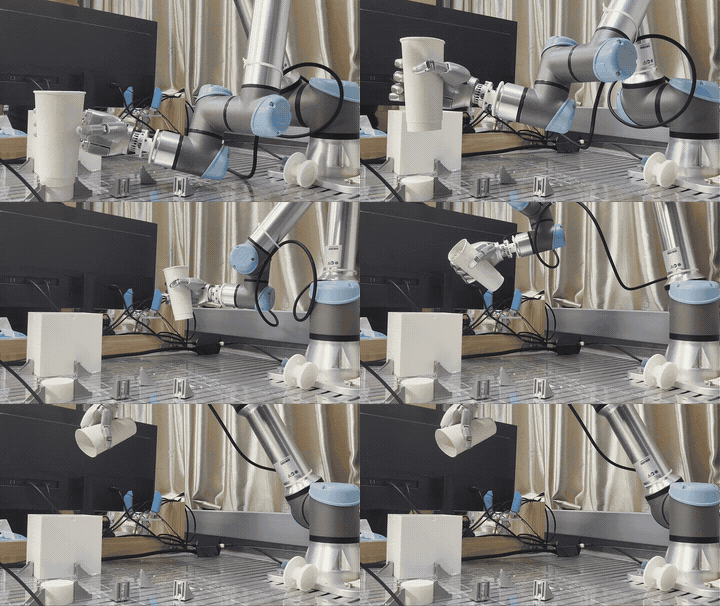
Pouring light ceramic beads
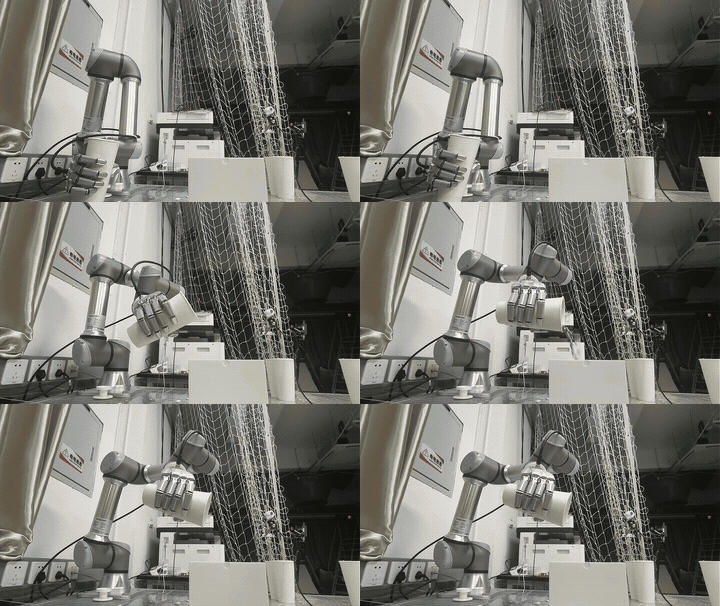
Pouring light ceramic beads

Pouring heavy steel beads
Pouring heavy steel beads

Featured
Real-Time Orientation Estimation
October 16, 2018
Real-Time Orientation Estimation
October 16, 2018

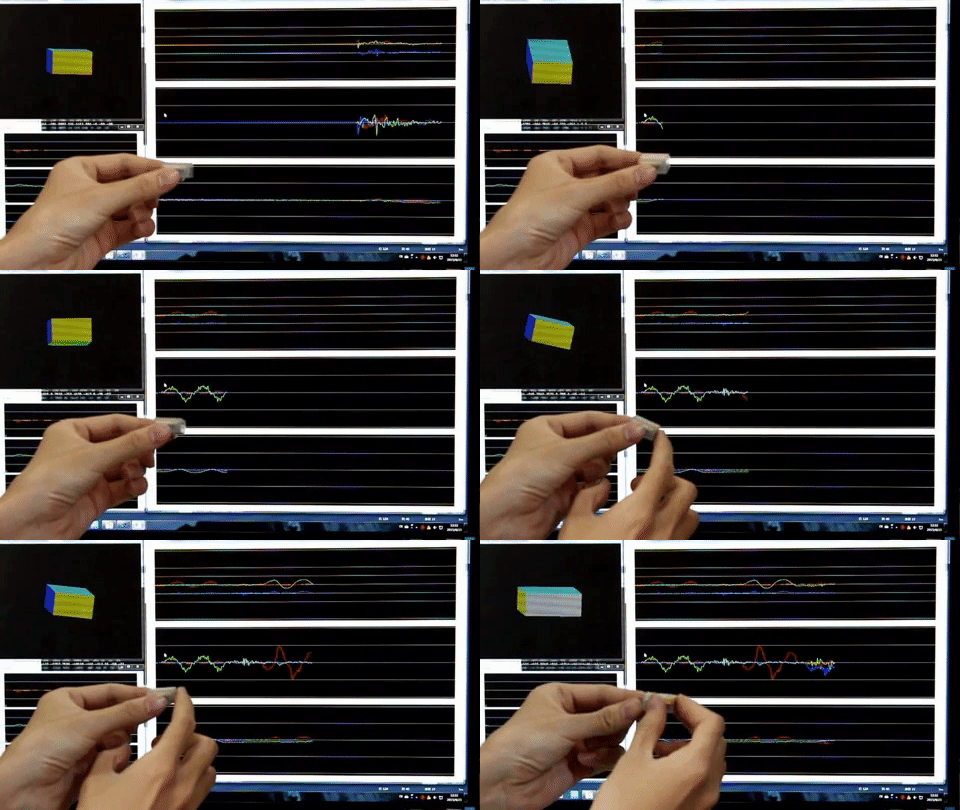
Orientation estimation performed via 3-axis accelerometer, 3-axis gyroscope, and 3-axis magnetometer sensor fusion

Read more →
October 16, 2018