• Research
  • People
  • Publications
  • Contact
  • Join
Menu

Wearable and Embodied AI Lab

Street Address
City, State, Zip
Phone Number

Your Custom Text Here

Wearable and Embodied AI Lab

  • Research
  • People
  • Publications
  • Contact
  • Join
E-Skin01.png

Embodied Magnetic/Waveguide E-Skin

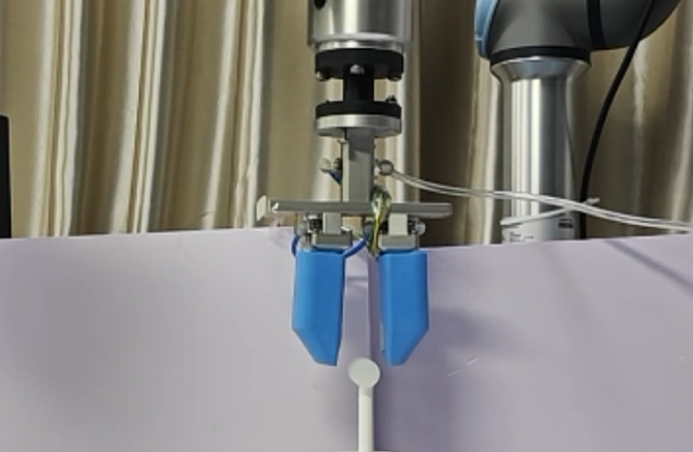
Robotic perception still relies heavily on vision, which limits manipulation under occlusion and poor lighting conditions. In contrast, humans can infer object properties by integrating tactile and proprioceptive feedback without sight.

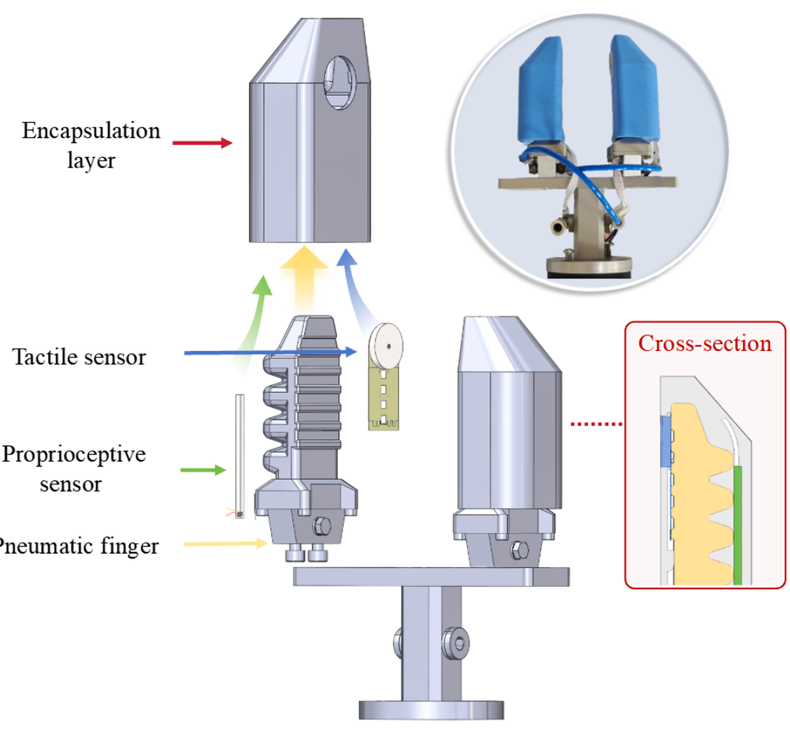
Inspired by this somatosensory mechanism, this work proposes a human-inspired multimodal electronic skin (e-skin) for nonvisual perception through tactile-proprioceptive sensing in a soft pneumatic finger. The proposed system integrates a compact magnetic tactile sensor and an ultrasonic waveguide proprioceptive sensor into a single soft elastomeric structure. A hierarchical fusion framework is developed to exploit the complementary sensing modalities, using Hall-derived tactile features and waveguide elongation features.

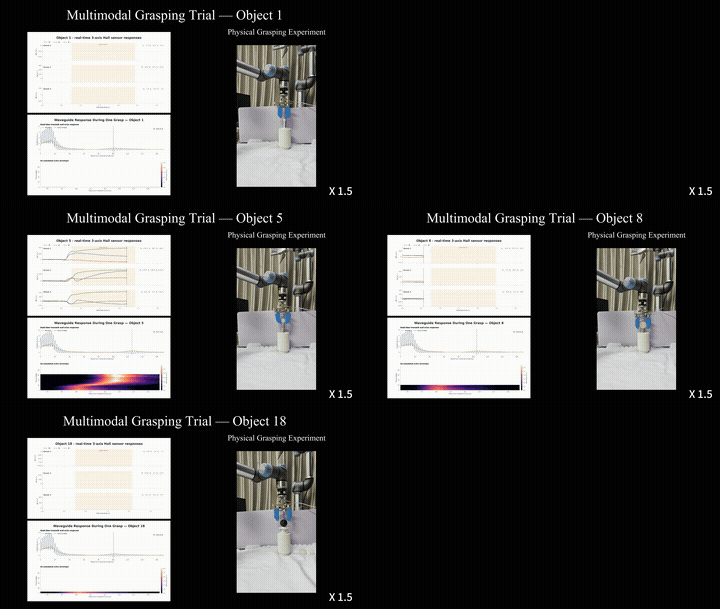
For closed-set recognition of 18 known object instances under controlled grasp conditions, the proposed framework achieves 93.70% classification accuracy, outperforming single-modality models and direct-feature fusion. These results demonstrate the potential of integrated tactile proprioceptive e-skins for non-visual object recognition in soft robotic manipulation.
Embodied Magnetic/Waveguide E-Skin

Robotic perception still relies heavily on vision, which limits manipulation under occlusion and poor lighting conditions. In contrast, humans can infer object properties by integrating tactile and proprioceptive feedback without sight.

Inspired by this somatosensory mechanism, this work proposes a human-inspired multimodal electronic skin (e-skin) for nonvisual perception through tactile-proprioceptive sensing in a soft pneumatic finger. The proposed system integrates a compact magnetic tactile sensor and an ultrasonic waveguide proprioceptive sensor into a single soft elastomeric structure. A hierarchical fusion framework is developed to exploit the complementary sensing modalities, using Hall-derived tactile features and waveguide elongation features.

For closed-set recognition of 18 known object instances under controlled grasp conditions, the proposed framework achieves 93.70% classification accuracy, outperforming single-modality models and direct-feature fusion. These results demonstrate the potential of integrated tactile proprioceptive e-skins for non-visual object recognition in soft robotic manipulation.

Robotic Gripper E-Skin Design

Robotic Gripper E-Skin Design

Magnetic tactile sensing is placed near the fingertip for contact sensing, and the ultrasonic waveguide proprioceptive sensor is positioned along the dorsal side for elongation sensing
E-SkinGIF01.gif
Featured
Real-Time Orientation Estimation
October 16, 2018
Real-Time Orientation Estimation
October 16, 2018

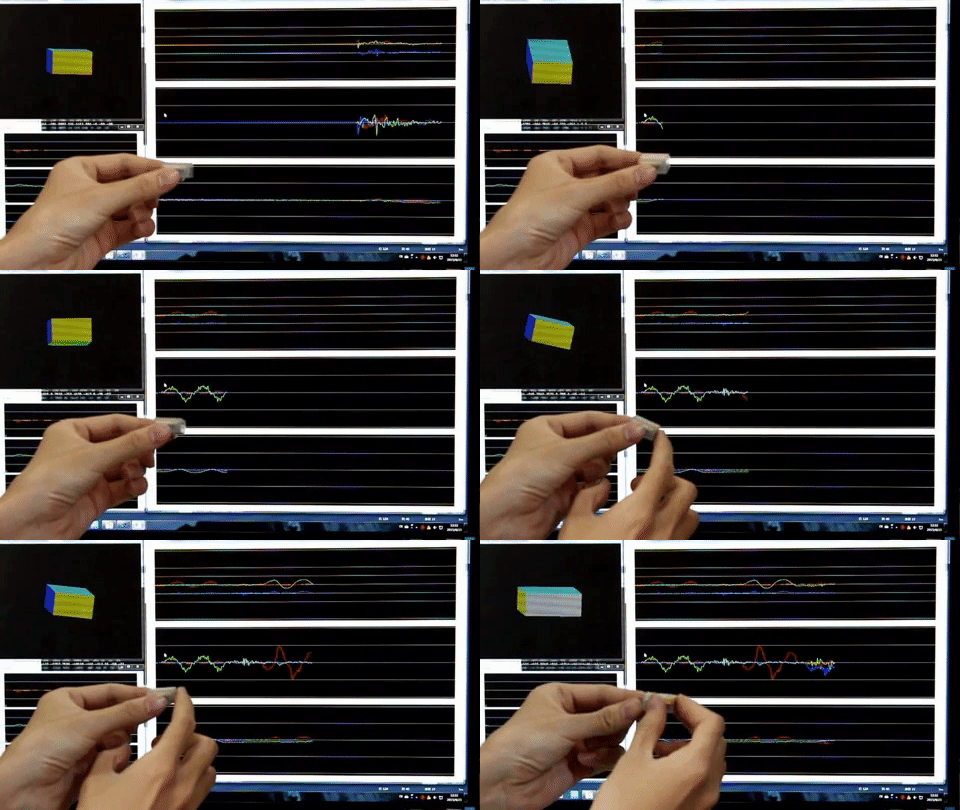
Orientation estimation performed via 3-axis accelerometer, 3-axis gyroscope, and 3-axis magnetometer sensor fusion

Read more →
October 16, 2018